
The Problem with Your Problem
Why most briefs solve the wrong thing brilliantly

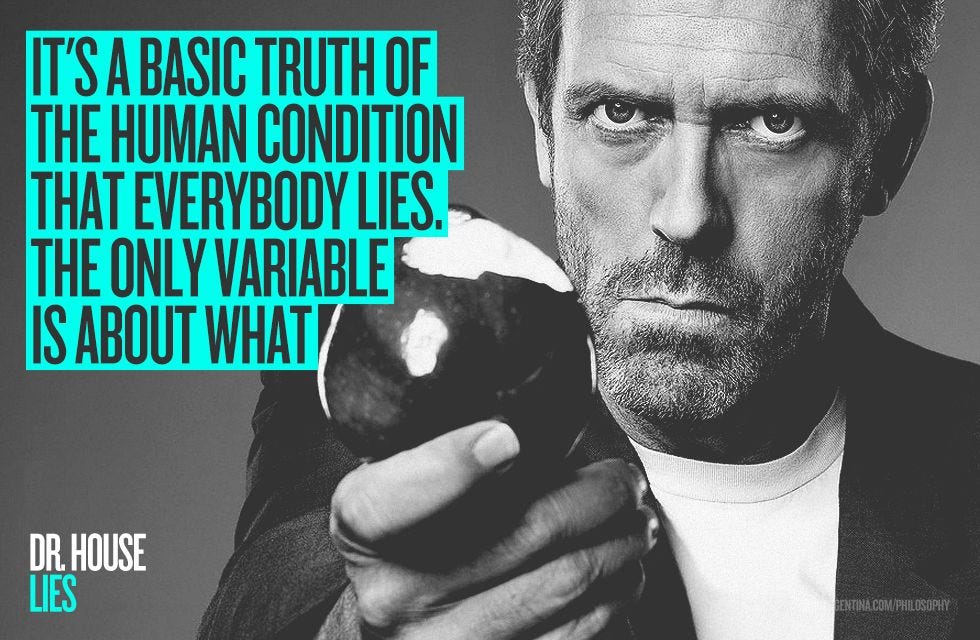
Everybody lies.
That’s not cynicism. It’s diagnosis. Dr. House knew it about patients. Strategists should know it about briefs. The problem you’ve been handed is almost never the problem you need to solve. And the biggest threat to effectiveness isn’t bad creative, limited budgets, or fragmented attention. It’s lazy thinking dressed up as strategy.
The job of a strategist isn’t to execute the brief. It’s to interrogate it until the truth surfaces.
Because marketers lie. Not maliciously. Mostly. They lie because it’s safer than admitting they don’t know. They lie because the real problem might implicate decisions they made six months ago. They lie because they’ve got eighteen months until they jump ship, and rocking the boat won’t get them to bonus day. They manipulate the truth, smooth over contradictions, and frame business failure as a communications opportunity because facing reality requires courage most organizations don’t reward.
Consumers lie too. Not because they’re dishonest. Because they don’t know how to articulate what they actually feel. Because they hide behind social conventions. Because when you ask them a stupid question in a focus group, they give you a stupid answer. “I want more choice” usually means “I’m overwhelmed.” “I care about sustainability” often translates to “I want to feel less guilty.” “It’s too expensive” might just be “I don’t see why this matters.”
So when a brief lands on your desk, assume nothing. Question everything. Because the stated problem is a symptom. Your job is to find the disease.
The Toothpaste Brief
(Or: How Marketers Avoid Solving Real Problems)
Let’s look at what bad briefing actually looks like. Not a parody. A pattern. The kind of thing that gets nodded through in meetings because everyone’s too polite, too busy, or too scared to call it out.
Business Objective: Increase toothpaste sales
Business Strategy: We will achieve our ambitious business objectives by increasing the number of units sold each month
Marketing Objective: Marketing will focus on the overall goal of increasing consumer sales in the oral care segment
Marketing Strategy: Selling more toothpaste requires getting more people to buy toothpaste. We feel a strategy focused on increasing purchase frequency is the best way of accomplishing our marketing objective.
Communications Objective: The goal of communications is clear: we need to sell more toothpaste
Communications Strategy: We will let consumers know that toothpaste is available for purchase
Proposition: Fresh breath. Clean teeth. Buy our toothpaste.
If you’ve ever seen a brief like this and not torn it up, you’re part of the problem. This isn’t strategy. It’s a Russian doll of tautology. Each layer just rephrases the same non-thought in slightly different words.
The business wants to sell more toothpaste, so marketing will help sell more toothpaste, and communications will communicate that there is toothpaste to sell. Congratulations. You’ve just wasted six weeks and a quarter million dollars on a campaign that says absolutely nothing, changes absolutely nothing, and will be forgotten before the media buy even ends.
The First Lie: Assuming the Problem is Real
Most briefs fail at the first hurdle. They accept the stated problem at face value.
“We need to increase penetration among 18-34s.”
“We need to shift perceptions around quality.”
“We need to drive awareness of our new range.”
Do you? Or is that just what the marketing director said in the kick-off because it sounded strategic?
Too often, we’re solving phantom problems. The client thinks the issue is awareness when the real problem is availability. They think it’s perception when it’s actually price. They think they need to talk to 18-34s when the entire category is collapsing among that cohort and no amount of TikTok content will change structural indifference.
The Ehrenberg-Bass Institute proved this decades ago. Penetration drives growth. Loyalty barely varies. Mental and physical availability matter most. Yet we’re still writing briefs about “engaging superfans” and “building communities” because it sounds more exciting than admitting the work is about being easier to remember and easier to buy.
Your first job is to ask: is this actually the problem?
Not: how do we solve the problem we’ve been given?
But: is the problem we’ve been given the one that matters?
If the brief says “shift perception,” ask: does perception predict purchase in this category, and if we shifted it, would behavior actually change? If the brief says “drive awareness,” ask: are we unavailable in memory or unavailable at shelf, and which matters more? If it says “increase loyalty,” ask: have we maximized penetration first, because if we haven’t, we’re backing the wrong horse.
The discipline is to go upstream. To find the root cause, not just treat the symptom. Because if you solve the wrong problem brilliantly, you’ve just produced expensive waste.
The Second Lie: Conflating What with How
The toothpaste brief commits the cardinal sin of brief writing. It conflates objectives with strategies, business goals with communication goals, and what we want people to do with how we plan to make them do it.
An objective is a destination. A strategy is a route. Confuse the two, and you end up with a brief that says “We will arrive at the destination by traveling to the destination.”
This isn’t pedantry. It’s the difference between a brief that unlocks thinking and one that just loops back on itself until everyone’s too exhausted to care.
Let’s be clear about definitions:
Business Objective = What the business needs to achieve (revenue, margin, market share, units sold)
Business Strategy = The commercial approach to achieving it (e.g., premiumisation, portfolio expansion, channel strategy, pricing architecture)
Marketing Objective = The customer behavior or perception shift required to deliver the business strategy (e.g., increase frequency among existing buyers, recruit lapsed users, expand occasions)
Marketing Strategy = How marketing will achieve that shift (e.g., reframe the category tension, own a new usage moment, disrupt a convention, leverage a cultural shift)
Communications Objective = The specific response communications must elicit (awareness, recall, trial, reappraisal)
Communications Strategy = The creative and media approach to eliciting that response (e.g., disruptive salience, emotional storytelling, behavioral nudge, social proof)
Proposition = The stimulus. What we will say or do to provoke the desired response.
Each level should unlock the next. Business strategy should suggest a marketing approach. Marketing strategy should imply a communications role. Communications strategy should lead you toward a specific kind of idea.
If your brief just says “sell more” at every level, you haven’t done the work. You’ve just restated the same wish in six different boxes.
The Third Lie: Mistaking Insights for Observations
Bad briefs are full of “insights” that are just facts dressed up in jargon.
“Consumers want convenience.”
“People care about value.”
“Families are time-poor.”
These aren’t insights. They’re observations. Worse, they’re the kind of generic observations you could apply to any category, any audience, any decade.
An insight explains why. It reveals the tension, contradiction, or unmet need that creates an opportunity for the brand. It’s not a description of behavior. It’s a diagnosis of motivation.
An observation says: people buy cheap toothpaste.
An insight says: people buy cheap toothpaste not because they don’t care about oral health, but because they don’t believe expensive toothpaste works any better, and they resent being played for fools.
An observation says: young people don’t engage with traditional advertising.
An insight says: young people don’t engage with traditional advertising not because they’re allergic to brands, but because most brand communication feels like an interruption designed for someone else’s parents.
An observation describes what’s happening.
An insight explains why it’s happening, and in doing so, suggests what might change it.
The test is simple: does your “insight” apply to ten other categories? If yes, it’s not an insight. It’s a truism. And you’re wasting everyone’s time.
The Fourth Lie: Ignoring the Category
Briefs love to talk about the brand. They love to talk about the consumer. They almost never talk about the market.
And yet the market is where the problem actually lives.
Who are you really competing with? Not your direct competitors. The other things people do instead. The mental shortcuts that make your category irrelevant. The occasions you’ve failed to own. The conventions that trap you in a race to the bottom.
When Oatly disrupted the milk category, they didn’t do it by making “better plant milk.” They did it by reframing the entire reason people bought milk in the first place. They made dairy the enemy. They turned milk-drinking into a statement. They understood that the competition wasn’t Alpro. It was centuries of cultural convention around what belongs in your coffee.
Your brief should force you to look sideways. What are the tired clichés in your category that everyone accepts? What are the rules no one questions? What are the codes that signal “this is how we do things here” even when those codes are driving people away?
If you’re writing a brief for toothpaste, the question isn’t “how do we sell more toothpaste?”
The question is: why do people treat toothpaste as a low-involvement commodity, and what would it take to make them care?
Maybe the answer is product. Maybe it’s occasion. Maybe it’s culture. But you won’t know until you stop assuming the category as it exists today is the category you need to compete in tomorrow.
The Fifth Lie: Confusing Response with Stimulus
This one trips up even good planners.
The brief asks: what do we want people to think, feel, or do?
That’s the response. The outcome. The change you’re trying to create.
But then it jumps straight to executional ideas without answering the more important question: what stimulus will provoke that response?
A proposition is not a positioning. It’s not what you want people to believe about you. It’s what you’re going to say or do that will make them believe it.
Let’s go back to toothpaste. If the desired response is “This brand understands my life,” the stimulus is not repeating “We understand your life” in fifteen different ways.
The stimulus is showing up in a moment, in a way, that proves it. It’s context. It’s behavior. It’s a truth so sharp they recognize themselves in it.
The best briefs don’t prescribe the answer. They frame the tension so clearly that the answer becomes obvious. They describe the shift you need to create, the barrier that’s preventing it, and the role communication can play in removing that barrier.
Everything else is just decoration.
How to Actually Write a Brief That Works
Writing a brief that unlocks great work is hard. It takes discipline, patience, and a willingness to throw away your first three attempts because they’re still too soft, too safe, too obvious.
Here’s the process that works:
1. Interrogate the Business Problem
Don’t accept the stated objective. Trace it back.
Why are sales declining? Is it penetration or frequency? Price or availability? Category decline or competitive loss? A product problem masquerading as a perception problem?
Keep asking “why” until you hit bedrock. The real problem is usually three levels deeper than the first brief.
2. Separate What from How
Force yourself to distinguish:
Business goal (what the company wants)
Marketing approach (how behavior needs to change)
Communications role (what communication specifically can do)
If your communications objective just repeats the business objective, start again.
3. Find the Consumer Tension
Not an observation. Not a demographic insight. A genuine psychological or cultural tension that your brand can resolve.
The best insights make you uncomfortable. They expose something people don’t want to admit. They name the thing everyone feels but no one says.
4. Understand the Competitive Context
Look at what competitors are doing. Look at what the category assumes to be true. Look for the white space, the rule no one’s breaking, the cliché everyone’s repeating.
Then decide: do we play the game better, or do we change the game entirely?
5. Write the Proposition as Stimulus, Not Response
Your proposition should be something you could actually say or do. Not “we’re the smart choice” (response). But “we’re the brand that tells you the truth your dentist won’t” (stimulus).
It should suggest a creative territory, a tone, a behavior. It should make the creative team lean forward, not lean back.
6. Test It Against Reality
Read your brief out loud. Does it sound like strategy, or does it sound like a string of buzzwords held together by wishful thinking?
Could you swap in another brand and have it still make sense? If yes, it’s not sharp enough.
Does it actually solve the problem, or does it just restate it in fancier language?
The Discipline No One Wants to Hear
Here’s the uncomfortable truth about briefing: most briefs are bad because we’re not willing to do the hard work.
We’re not willing to push back on the client when they hand us a mess.
We’re not willing to admit we don’t have an insight yet.
We’re not willing to throw away a week’s work and start again because the thinking isn’t there.
We want the brief to be done. We want to move to creative. We want to look like we’re making progress.
But a bad brief doesn’t make progress. It just moves the problem downstream, where it gets solved badly, expensively, or not at all.
The best briefs are written slowly. They’re rewritten multiple times. They’re interrogated, challenged, torn apart, and rebuilt. The brief is where the idea starts. If the brief is lazy, the work will be lazy. If the brief is derivative, the work will be derivative. If the brief is just a box-ticking exercise to keep the process moving, don’t be surprised when the work is forgettable.
The best briefs don’t just inform creative work. They provoke it. They create tension. They force you to think differently. Because you can’t creative-direct your way out of a strategic failure.
What This Actually Looks Like
Let’s rewrite the toothpaste brief. Properly.
Business Objective: Reverse three years of value-share decline in the premium toothpaste segment
Business Strategy: Rebuild pricing power by shifting the category conversation from commodity hygiene to long-term oral health investment
Marketing Objective: Increase purchase frequency among existing category buyers who currently default to the cheapest option at shelf
Marketing Strategy: Reframe brushing from a hygiene habit to a health ritual by leveraging the cultural shift toward preventative wellness
Communications Objective: Make premium toothpaste feel like a non-negotiable investment, not an optional upgrade
Communications Strategy: Use emotional storytelling and social proof to build a new cultural code around oral health as a visible signal of self-care
Consumer Insight: People don’t buy cheap toothpaste because they don’t care about their teeth. They buy cheap toothpaste because they don’t believe expensive toothpaste does anything different, and they resent being upsold on something that feels interchangeable.
Proposition: Your mouth is the most honest part of your body. Treat it accordingly.
Now look at the difference.
Every line is doing work. Every level unlocks the next. The business problem is clear. The marketing approach is specific. The communications role is defined. The insight explains behavior. The proposition is a stimulus that suggests a creative territory.
This brief could be wrong. But it’s not empty. It gives you something to react to, something to build on, something to make better.
That’s what a brief should do.
The Real Question
The irony of bad briefing is that it masquerades as rigour. It comes with templates and stakeholder sign-off and carefully formatted decks. It looks like strategy.
But strategy isn’t a form. It’s a way of thinking.
And thinking is hard. It means admitting when you don’t know. It means rejecting the first three answers because they’re not good enough. It means being willing to say “this brief isn’t ready” when everyone’s waiting for you to just get on with it.
Most briefs are bad because we’ve stopped treating them as the craft they are. We’ve turned them into admin. A hurdle to clear before the “real work” starts.
But the brief is the real work. It’s where you decide what problem you’re solving. And if you get that wrong, everything downstream is just expensive noise.
So the next time someone hands you a brief, ask yourself: is this the problem worth solving?
If the answer is no, send it back.
If the answer is “I don’t know yet,” keep digging.
And if the answer is yes, write it down in a way that makes everyone who reads it understand exactly why.
Because everybody lies.
And it’s your job to find the truth.
For everyone who asked for the follow-up: here it is.
123 questions to help you write briefs that unlock better work.
https://open.substack.com/pub/rewireurmind/p/the-questions-that-matter?r=2di01&utm_campaign=post&utm_medium=web&showWelcomeOnShare=true
this is soo helpful. thank you for defining the terms and then providing a good example! I am going to use this framework to analyze company strategies.